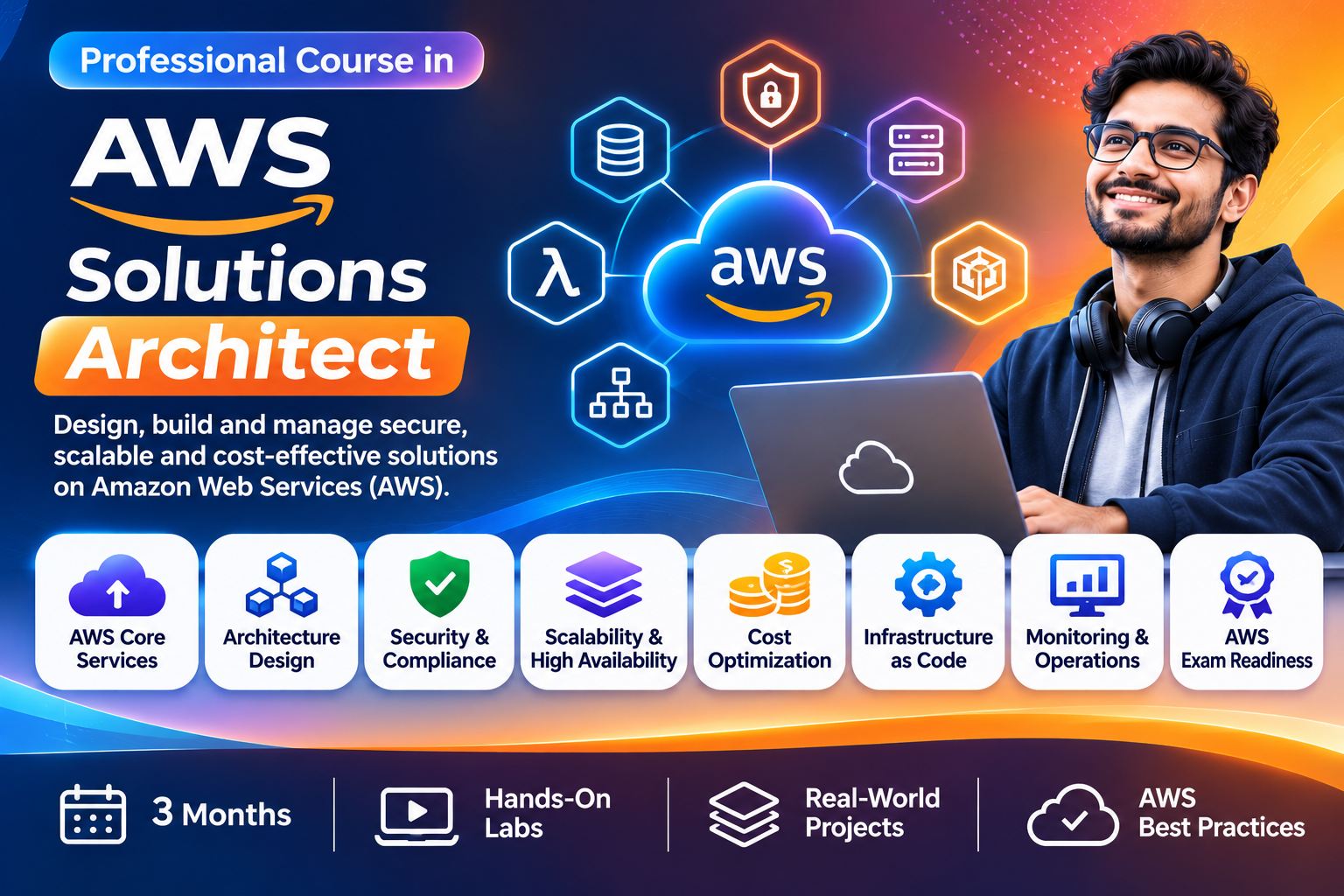
Cloud architecture is about choosing the right services and connecting them to build systems that are secure, dependable and capable of scaling with business needs. The AWS Solutions Architect course introduces the core concepts of Amazon Web Services and explores how cloud infrastructure, compute, storage, networking, databases and security work together. Learn to evaluate architecture requirements, select suitable AWS services and plan solutions with attention to performance, reliability and cost.
What You'll Learn
Start with the AWS cloud platform, its global infrastructure and essential services. Explore how Identity and Access Management, virtual private networks and compute resources are used to build and operate cloud environments. Understand storage options, database services and application components, and learn how to select them for different workloads.
Move into architecture design concepts such as scalability, high availability, fault tolerance and cost optimisation. Study monitoring and automation practices, container services, security controls and disaster recovery approaches. The course also introduces migration planning for existing applications and the movement of data into and out of AWS environments.
By connecting these topics, you can develop a practical understanding of how to plan AWS solutions for different technical and business requirements. The learning path also covers AWS service selection, solution planning, architecture best practices and cost estimation.
- Understand AWS cloud concepts and infrastructure
- Explore core AWS services and their use cases
- Work with Identity and Access Management (IAM)
- Understand Amazon VPC and cloud networking
- Explore compute services such as EC2
- Understand storage services including Amazon S3 and EBS
- Explore relational and NoSQL database options
- Understand load balancing and Auto Scaling
- Explore application and serverless services
- Design scalable and highly available architectures
- Plan fault-tolerant cloud implementations
- Apply AWS security and access management concepts
- Understand monitoring and automation practices
- Explore container services and deployment options
- Understand disaster recovery planning
- Evaluate cloud migration requirements
- Select AWS services for specific workloads
- Estimate cloud costs and identify cost controls
AWS Services and Technologies
Explore a broad range of AWS technologies referenced in the course, including EC2, EKS, Lightsail, AWS Batch, Elastic Beanstalk, Fargate, IAM, VPC, S3, EBS, RDS, DynamoDB, Redshift, ElastiCache, Route 53, CloudFront, CloudWatch, CloudTrail, KMS and CloudFormation.
Practical Architecture Scenarios
Apply cloud architecture concepts to scenarios such as creating a VPC with public and private subnets, deploying web servers behind a load balancer with Auto Scaling, and configuring secure access through an RD Gateway. These examples help connect AWS services with common infrastructure design requirements.
Who Can Benefit?
This course is relevant to aspiring cloud architects, solutions architects, programmers, cloud developers, cloud software engineers and DevOps professionals. It can also help technology learners who want to understand AWS infrastructure and develop skills in cloud solution planning.


 Learn New Skills. Build Your Future With EdyLearn.


 Cloud Computing & DevOps