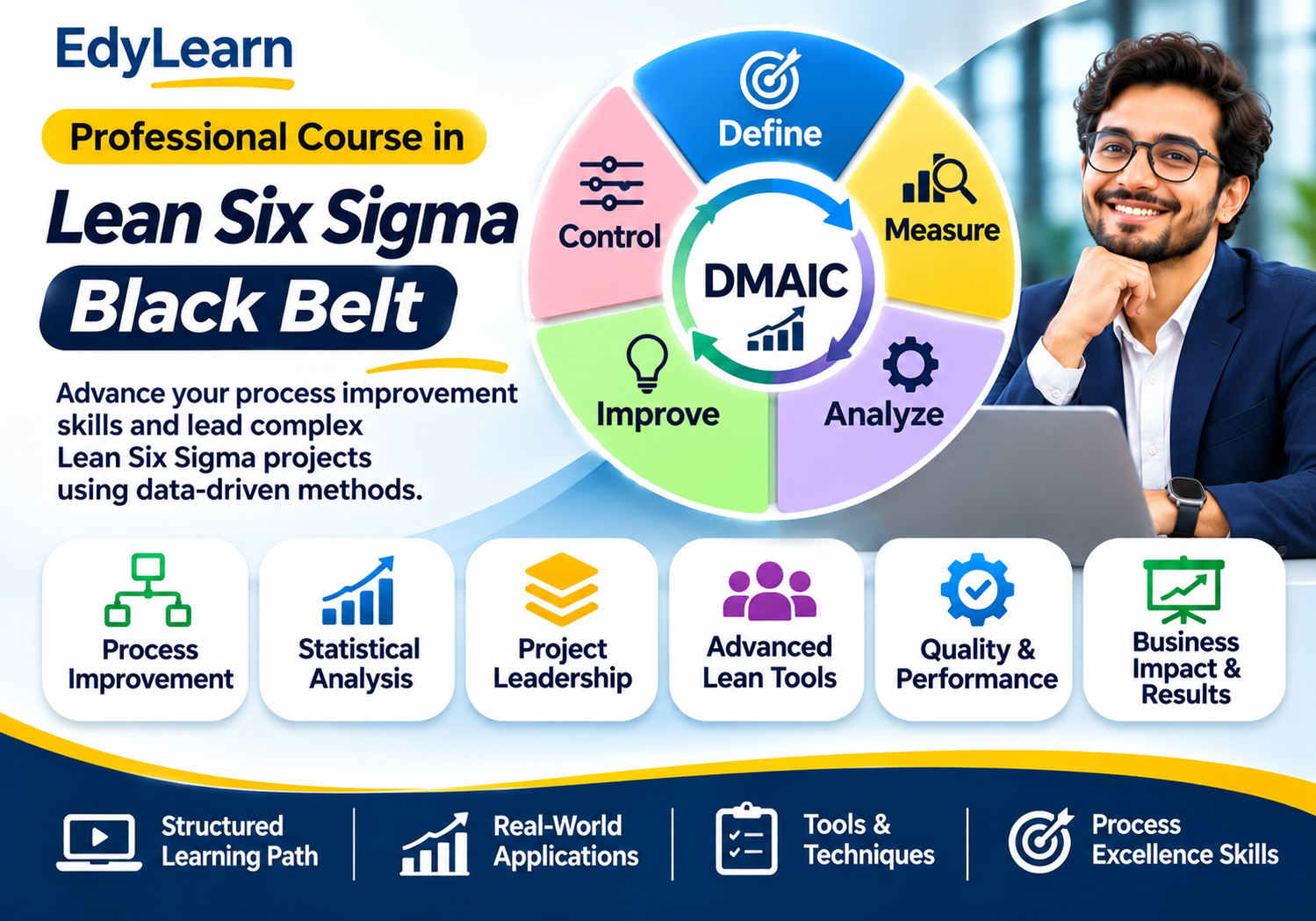
Develop advanced process improvement and quality management skills with Lean Six Sigma Black Belt training. Explore statistical analysis, project management, team leadership and strategic alignment while learning how to address complex business problems through structured, data-driven improvement methods.
What You'll Learn
This course builds on the fundamentals of Lean Six Sigma and takes learners deeper into the tools used to improve performance across business processes. Understand how to identify improvement opportunities, evaluate customer expectations, establish project priorities and connect improvement initiatives with organizational objectives.
Follow the DMAIC framework through Define, Measure, Analyze, Improve and Control. Study project charters, Voice of the Customer, CTQ requirements, Cost of Poor Quality, process mapping, SIPOC and project performance metrics. Explore team responsibilities, financial evaluation and project selection methods.
Develop stronger analytical capabilities through probability distributions, descriptive and inferential statistics, measurement system analysis, process capability and hypothesis testing. The curriculum also covers regression analysis, Design of Experiments, factorial experiments and improvement solution evaluation.
Learn how to sustain process gains using Lean controls, 5S, Kanban, mistake-proofing, Statistical Process Control, control charts and control plans. The course also introduces practical applications of Minitab and structured improvement projects.
- Apply Lean Six Sigma concepts to complex processes
- Evaluate customer needs and project priorities
- Develop project charters, goals and performance metrics
- Use process mapping, SIPOC and Value Stream Maps
- Understand advanced statistical analysis
- Perform Measurement System Analysis and Gage R&R
- Evaluate process capability and performance
- Interpret probability distributions and statistical tests
- Explore correlation and regression analysis
- Understand Design of Experiments and factorial designs
- Evaluate solutions using prioritization and cost-benefit tools
- Apply Lean controls, Kanban and mistake-proofing
- Interpret SPC charts and process control methods
- Build control plans to maintain improvements
By the end of the learning journey, you will have a structured understanding of advanced quality improvement techniques and how they support operational efficiency, process consistency and informed business decisions.


 Learn New Skills. Build Your Future With EdyLearn.


 Quality Management