Course Category

Course categoryProduct & Design
5.0 / 5
Course Rating

AI-Powered Product Management

  • 6 months
  • 5.2K learners
AI-Powered Product Management
$ 890.00
  • CategoryProduct & Design
  • Rated5.0 / 5
  • Learners5.2K
  • Duration6 months
Show More
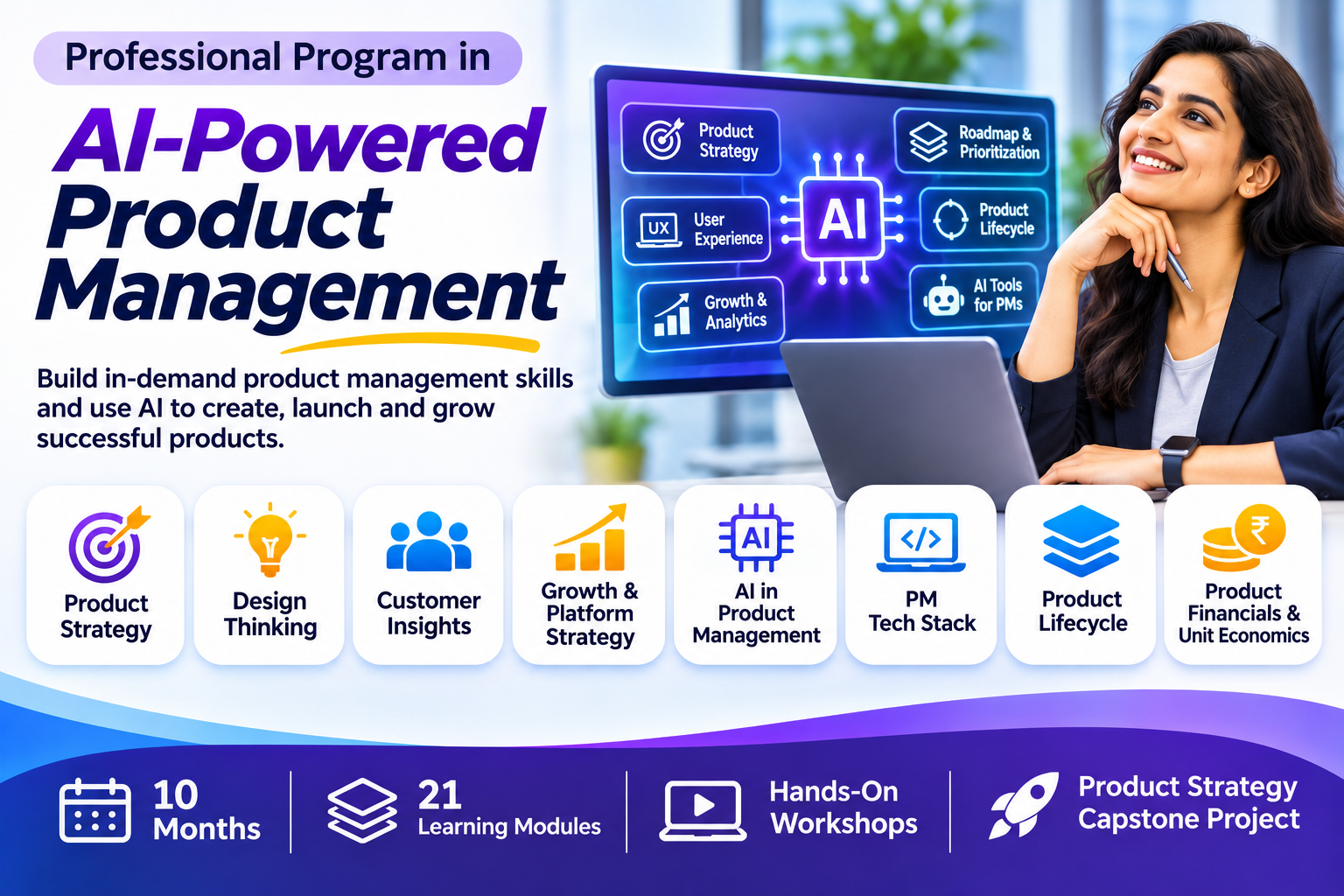
Great products are built by understanding customers, shaping a clear vision and making the right decisions throughout the product lifecycle. This AI-Powered Product Management course explores the complete product journey, from discovering user needs and defining strategy to prioritising roadmaps, designing experiences, launching products and driving growth. It also introduces the practical use of generative AI in research, product planning, prototyping and decision-making.

What You'll Learn

Develop a structured approach to product management and understand how product managers work with design, engineering, marketing and business teams. Explore customer value creation, product leadership, strategic planning, business models, pricing and financial performance. Learn how to translate customer insights into product opportunities, evaluate competing priorities and create roadmaps that support business objectives. The curriculum also covers design thinking, user experience, wireframing, rapid prototyping, platform strategy and product lifecycle management. Artificial intelligence is woven into the product management journey. Explore how generative AI tools can assist with market research, user insight analysis, product ideation, personalisation, trend discovery and prioritisation. Understand how AI capabilities can contribute to product strategy while keeping customer needs and business outcomes at the centre.
  • Understand the role and responsibilities of a product manager
  • Build product leadership and stakeholder influence skills
  • Identify customer problems and define product opportunities
  • Develop product vision and strategic direction
  • Prioritise features and create product roadmaps
  • Explore product business models and pricing strategies
  • Apply design thinking to product development
  • Interpret consumer behaviour and market insights
  • Understand UX principles for product managers
  • Connect product decisions with measurable outcomes
  • Explore new product development approaches
  • Create wireframes and rapid prototypes
  • Understand platform strategy and growth opportunities
  • Manage product lifecycle and AI-related strategy
  • Explore essential tools used by product teams
  • Use generative AI for research and product ideation
  • Apply AI to personalisation and trend analysis
  • Understand product financials and unit economics
  • Evaluate customer value and product performance
  • Develop and present a product strategy capstone

Product Management Across the Lifecycle

Explore the responsibilities involved in taking a product from an initial idea to market adoption and continued growth. Learn how product discovery, strategy, prioritisation, design, development and performance evaluation work together to create useful and commercially viable products.

AI in Product Management

Discover ways to use AI tools such as ChatGPT, Gemini and other generative AI platforms for market research, capturing user feedback, improving UX concepts and supporting product prioritisation. Understand how AI can assist product teams without replacing the need for sound judgement and customer understanding.

Who Can Benefit?

This course is suitable for aspiring and practising product managers, business professionals, project and team leads, entrepreneurs, marketing professionals, designers and technology specialists interested in product strategy. It can also help professionals planning a transition into product management roles.
Show More

Programme Structure

The learning path combines product management foundations with leadership, customer value, strategy, design, AI applications and commercial decision-making. It progresses from understanding the product manager's role to developing and presenting a product strategy.

Learning Path

Begin with an introduction to the programme, its learning structure and the expectations for the product management journey. Get familiar with the key themes that will be explored throughout the course.

Understand product management as a professional discipline and examine the competencies required to work effectively in product roles.
  • Product management across different industries
  • The KASH framework for product manager competencies
  • Understanding personal strengths and working styles
  • Preparing for a transition into product management

Explore how product managers guide teams, influence decisions and build alignment across different business functions.
  • Leadership in product environments
  • Influencing stakeholders and cross-functional teams
  • Communication and collaboration
  • Building credibility and driving alignment

Learn to connect product decisions with customer needs and business value. Explore how teams identify meaningful problems and develop solutions that matter to users.
  • Understanding customer needs and expectations
  • Identifying customer problems and opportunities
  • Defining and communicating value propositions
  • Connecting customer value with product outcomes

Get introduced to AI concepts and examine how artificial intelligence can support product discovery, planning and decision-making.
  • Introduction to AI in product management
  • Generative AI capabilities and practical applications
  • AI-assisted research and idea development
  • Opportunities and considerations for AI-enabled products

Learn how to define a product's direction and connect strategic choices with customer needs and organisational goals.
  • Product vision and strategic objectives
  • Market and competitive understanding
  • Product positioning and differentiation
  • Aligning strategy with business priorities

Explore methods for evaluating product opportunities, making trade-offs and organising initiatives into a practical roadmap.
  • Prioritising features and product initiatives
  • Balancing customer value and business impact
  • Roadmap planning and sequencing
  • Communicating priorities to stakeholders

Understand the commercial foundations of a product and examine how business models and pricing choices influence its market performance.
  • Product business model concepts
  • Revenue models and monetisation approaches
  • Pricing strategy and value perception
  • Connecting product value with commercial goals

Use a human-centred approach to understand user problems and explore possible product solutions.
  • Design thinking principles
  • Empathy and problem definition
  • Ideation and solution exploration
  • Prototyping and iterative validation

Discover how consumer behaviour and customer insights can guide product choices and improve the relevance of product experiences.
  • Understanding consumer needs and behaviour
  • Gathering and interpreting user insights
  • Using evidence to support product decisions
  • Connecting customer feedback with product improvements

Understand the user experience principles that help product managers collaborate with design teams and create intuitive products.
  • User experience fundamentals
  • User journeys and interaction design
  • Usability and customer experience considerations
  • Working with UX design teams

Focus on product outcomes rather than simply tracking completed tasks. Explore how new product development connects ideas, validation and business objectives.
  • Outcome-driven product thinking
  • Defining product success measures
  • New product development concepts
  • Evaluating product progress and impact

Explore ways to represent product ideas visually and create early versions of a solution for discussion and validation.
  • Wireframe fundamentals
  • Mapping product screens and user flows
  • Rapid prototyping approaches
  • Using prototypes to communicate and test ideas

Understand platform-based products and the strategic decisions that influence their adoption, ecosystem development and long-term growth.
  • Platform business concepts
  • Platform ecosystems and network effects
  • Growth opportunities and adoption
  • Strategic considerations for platform products

Examine product lifecycle stages and consider how AI can contribute to product improvement, differentiation and strategic planning.
  • Product lifecycle stages and management
  • Product performance and growth considerations
  • AI opportunities across product stages
  • Strategic planning for AI-enabled products

Become familiar with the types of digital tools that support product planning, collaboration, research and delivery.
  • Product planning and documentation tools
  • Collaboration and workflow platforms
  • Research and analytics tools
  • Tools supporting product design and delivery

Move beyond introductory AI applications and examine how advanced generative AI capabilities can support product strategy and customer-focused innovation.
  • Advanced AI applications in product management
  • AI-assisted research and insight generation
  • Personalisation and trend analysis
  • Using AI frameworks in product decisions

Bring together the key concepts of product management in an applied strategy project. Work through product-related decisions and develop a structured approach to presenting a product strategy.
  • Define a product opportunity and its target users
  • Develop a product vision and strategic direction
  • Consider prioritisation and roadmap choices
  • Present the proposed product strategy

Explore the relationship between consumer psychology and buying behaviour. Understand how insights into customer responses can inform product positioning and marketing decisions.
  • Introduction to neuromarketing
  • Consumer psychology and purchase behaviour
  • Customer perception and decision patterns
  • Applying behavioural insights to product choices

Use a workshop-based learning format to revisit product management concepts and explore how they apply to practical product situations.
  • Product management problem-solving
  • Applying strategy and prioritisation concepts
  • Collaborative product discussions
  • Connecting product choices with business objectives

Understand the financial measures that help product teams assess commercial performance, growth potential and business sustainability.
  • Product financial fundamentals
  • Understanding unit economics
  • Revenue, cost and profitability considerations
  • Using financial insights in product decisions

Who Should Take This Course?

  • Aspiring and practising product managers
  • Product owners and product team members
  • Project managers and team leaders
  • Business analysts and strategy professionals
  • Marketing and customer experience professionals
  • UX designers and technology professionals
  • Entrepreneurs and business founders
  • Professionals planning a move into product management

Eligibility Requirements

  • Bachelor's degree or equivalent qualification from a recognised institution
  • 2+ years of professional work experience preferred
  • Interest in product development, business strategy or technology
  • Motivation to build product management capabilities
The experience and education points above are taken from the source programme's eligibility information. Confirm your own admission criteria before publishing them as EdyLearn requirements.

What You Will Learn

  • Product management principles and responsibilities
  • Product leadership and stakeholder influence
  • Customer discovery and value creation
  • AI applications in product management
  • Product vision and strategic planning
  • Feature prioritisation and roadmap development
  • Product business models and pricing
  • Design thinking and consumer insights
  • UX design and rapid prototyping
  • Outcome-driven product development
  • Platform strategy and product growth
  • Product lifecycle and AI strategy
  • Product financials and unit economics
  • Product strategy development and presentation


AI-Powered Product Management

STAY CONNECTED WITH EDYLEARN

Subscribe To Our Newsletter

Get learning updates, new course announcements and useful insights delivered straight to your inbox.

Learn. Grow. Achieve.

00

Learn At Your Pace
Flexible Learning

00

Build Useful Skills
Practical Learning