Course Category

Course categoryProduct & Design
4.9 / 5
Course Rating

Advanced UI/UX Design with Generative AI

  • 5 Months
  • 8.2K learners
Advanced UI/UX Design with Generative AI
$ 950.00
  • CategoryProduct & Design
  • Rated4.9 / 5
  • Learners8.2K
  • Duration5 Months
Show More
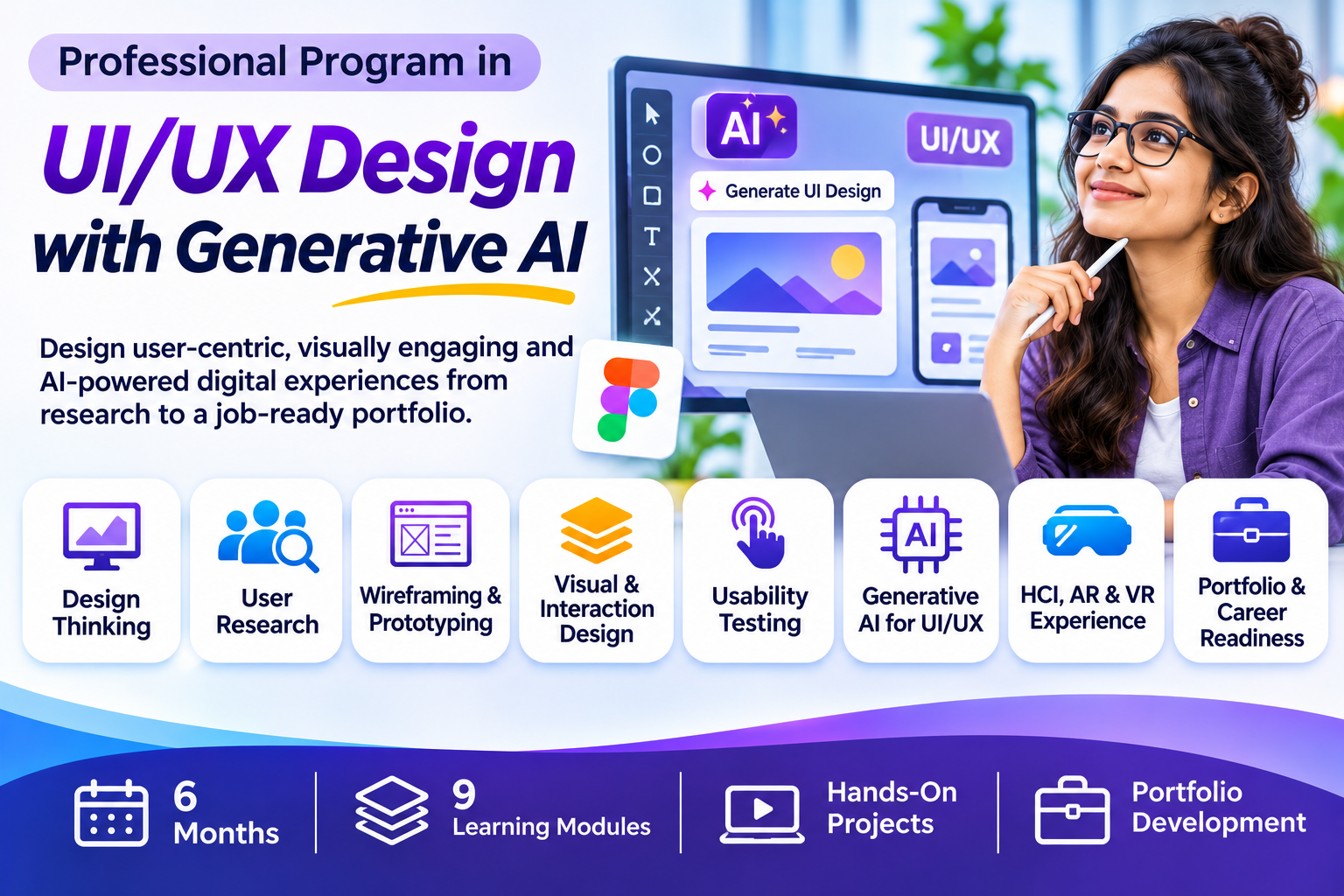
Designing a successful digital product involves much more than creating attractive screens. It requires an understanding of users, thoughtful problem-solving and the ability to turn ideas into clear, intuitive experiences. This Advanced UI/UX Design with Generative AI course explores the design process from research and design thinking to visual communication, wireframing, prototyping and usability evaluation. It also introduces AI-assisted design workflows and emerging areas such as Human-Computer Interaction (HCI), AR and VR.

What You'll Learn

Build a foundation in user interface and user experience design, then explore how designers research user needs, organise information and create meaningful digital interactions. Learn to develop user personas, empathy maps and design concepts that respond to real user problems. Explore visual design principles, wireframes, interactive prototypes, microinteractions and usability evaluation. Understand how to document design decisions, prepare project handoffs and collaborate with stakeholders throughout the product development process. The programme also introduces generative AI tools that can assist with research, UX writing, ideation, visual creation and rapid prototyping. You will explore how these tools can support different stages of the design workflow, alongside emerging applications of HCI and immersive AR/VR experiences.
  • Understand UI and UX design principles
  • Apply design thinking to user problems
  • Plan and conduct UX research
  • Create user personas and empathy maps
  • Interpret user needs and research findings
  • Apply visual design fundamentals
  • Develop wireframes for digital interfaces
  • Create prototypes and interactive experiences
  • Design microinteractions for better usability
  • Evaluate and test user experiences
  • Understand Human-Computer Interaction (HCI)
  • Explore AR and VR concepts in UI/UX
  • Use AI tools for design ideation and research
  • Explore AI-assisted wireframing and prototyping
  • Improve UX content and interface microcopy
  • Prepare design documentation
  • Manage project handoffs to development teams
  • Communicate design decisions with stakeholders
  • Build and organise a professional design portfolio
  • Apply learning through a UI/UX capstone project

Design Tools and AI-Assisted Workflows

Explore design and collaboration tools used in modern UI/UX workflows. The source curriculum references Figma, Miro, Maze, Uizard, Visily and MockFlow, along with generative AI tools such as ChatGPT, Jasper, Runway and Fontjoy. Tool availability and hands-on access may depend on the learning setup offered by EdyLearn.

Portfolio and Practical Application

Connect research, design, prototyping and evaluation through practical design exercises. The learning journey culminates in a UI/UX capstone project, giving learners an opportunity to bring different stages of the design process together and present their work in a structured portfolio.

Who Can Benefit?

This course can benefit aspiring UI/UX designers, graphic and visual designers, web designers, product design enthusiasts, creative professionals and technology learners who want to understand user-centred digital design. It can also be useful for professionals looking to add AI-assisted design methods to their existing workflow.
Show More

Programme Overview

Follow a structured UI/UX learning journey covering design foundations, user research, visual design, prototyping, usability, professional collaboration and emerging design technologies. The programme includes nine core learning modules, progressing from introductory concepts to a final design project.

Learning Path

Get introduced to the learning journey, programme structure and the key areas of UI/UX design that will be explored throughout the course.
  • Understanding the course structure and learning objectives
  • Introduction to UI/UX design as a discipline
  • Overview of the design process and its applications

Build an understanding of user interface and user experience concepts. Learn how design thinking helps teams identify problems, explore ideas and develop user-centred solutions.
  • UI and UX concepts and their differences
  • Principles of user-centred design
  • Design thinking and problem-solving
  • Understanding user needs and design opportunities

Discover how research helps designers understand users, their expectations and the challenges they face when interacting with products.
  • Introduction to UX research methods
  • Collecting and interpreting user information
  • Creating empathy maps and user personas
  • Translating research findings into design direction

Move from early design concepts to visual layouts and interactive experiences. Explore how structure, visual hierarchy and interaction details shape a digital product.
  • Visual design principles and interface layouts
  • Wireframing and screen structure
  • Prototyping and interaction flows
  • Microinteractions and interactive design elements
  • Using AI-assisted tools to explore design ideas and prototypes

Learn how to assess a design from the user's perspective and identify areas that need improvement. Focus on evaluating whether an interface is clear, accessible and easy to use.
  • Usability evaluation concepts
  • Reviewing user flows and interface interactions
  • Identifying usability issues
  • Using feedback to refine design solutions

Understand how design work is documented and communicated to the people responsible for development and delivery.
  • Preparing design documentation
  • Organising design assets and specifications
  • Project handoff to development teams
  • Communicating with stakeholders
  • Managing feedback and design revisions

Explore how to organise and present design work in a portfolio. Learn to communicate the thinking, research and decisions behind a design solution.
  • Structuring a UI/UX design portfolio
  • Presenting projects and design case studies
  • Explaining the design process and outcomes
  • Understanding professional portfolio platforms
  • Career direction in UI/UX design

Explore Human-Computer Interaction and understand how people interact with digital systems. Get introduced to immersive design experiences and the role of AR and VR in user experience.
  • Human-Computer Interaction fundamentals
  • Interaction patterns and user behaviour
  • Introduction to augmented and virtual reality
  • AR/VR and immersive experience concepts
  • Exploring immersive design prototypes

Bring together the concepts covered in the programme through a final design project. Apply user research, design thinking, interface design, prototyping and evaluation to develop and present a complete design solution.
  • Define a user problem and design objective
  • Apply research and design principles
  • Develop interface concepts and prototypes
  • Review usability and refine the experience
  • Present the final design work

Generative AI Design Tools

Explore AI-supported design workflows for research, writing, visual creation and prototyping. The source course references tools such as:
  • ChatGPT and Jasper for research support and UX writing
  • Uizard, Visily and MockFlow for AI-assisted wireframing
  • Runway and Fontjoy for visual exploration and creative work
  • Figma, Miro and Maze for design, collaboration and testing workflows

Who Should Take This Course?

  • Aspiring UI/UX designers
  • Graphic and visual designers
  • Web and digital designers
  • Product design enthusiasts
  • Creative and content professionals
  • Technology professionals interested in user experience
  • Professionals exploring a career in digital design
  • Designers interested in AI-assisted creative workflows

Requirements

  • Interest in digital products and user-centred design
  • Basic computer and internet skills
  • Willingness to practise design concepts and tools
  • Creative thinking and problem-solving interest
The source does not specify a strict academic qualification or prior work experience requirement. These are suggested learning prerequisites, not formal admission criteria.

What You Will Learn

  • UI/UX design principles and design thinking
  • UX research methods and user personas
  • Empathy mapping and user problem analysis
  • Visual design and interface layouts
  • Wireframing and interactive prototyping
  • Microinteractions and interaction design
  • Usability evaluation and design testing
  • Human-Computer Interaction fundamentals
  • AR/VR concepts for immersive experiences
  • AI-assisted research, writing and prototyping
  • Design documentation and project handoff
  • Stakeholder communication
  • Portfolio development and case study presentation
  • UI/UX capstone project development


Advanced UI/UX Design with Generative AI

STAY CONNECTED WITH EDYLEARN

Subscribe To Our Newsletter

Get learning updates, new course announcements and useful insights delivered straight to your inbox.

Learn. Grow. Achieve.

00

Learn At Your Pace
Flexible Learning

00

Build Useful Skills
Practical Learning